What you'll actually take home
Put your own rate in. Nothing here is hidden behind a form or an email address.
* The margin comes out of the assignment rate before a gross wage exists, so it reduces the pay that tax and National Insurance are charged on. Removing £18 of margin would not add £18 to gross pay either, because employer’s National Insurance and the apprenticeship levy are charged on the extra. The figures quoted are for a basic-rate taxpayer opted out of the workplace pension: £11.22 a week, £44.88 four-weekly, £48.62 monthly, all £583.44 a year. Staying in the pension or paying higher-rate tax changes them. This is how every compliant umbrella margin works, not something particular to us. The breakdown above shows your own figures.
An illustration, not a quote or an offer of employment. It uses 2026/27 rates for a worker paid weekly across 52 weeks, with rolled-up holiday pay at 12.07% included in gross pay. Your actual payslip depends on your tax code at the time, your cumulative earnings for the year, and the hours you actually work. A Key Information Document with figures specific to your assignment is issued before you start.
What each deduction actually is
The order matters. Three of these come off before you have a wage at all.
-
01
Assignment rate
What the agency pays us for your work. This is not your wage and it is not what you were quoted as an hourly rate if that quote was a PAYE rate. It is the whole cost of employing you, and everything below comes out of it.
-
02
Our margin
£18 a week, £72 four-weekly, £78 monthly. The only line on the payslip we keep. It does not change with your rate, so the more you earn the smaller a share of it we take.
-
03
Employer's National Insurance: the one nobody explains
This is the line that causes most of the arguments about umbrella employment, so here it is plainly. As your employer we owe HMRC 15% on your pay above £96 a week. In umbrella work that cost comes out of the assignment rate rather than being paid by the agency on top, which is why an umbrella assignment rate is normally quoted higher than the equivalent PAYE rate.
It is not a fee, we do not keep a penny of it, and every compliant umbrella deducts it the same way. What varies between providers is whether they show it to you as its own line or bury it. We show it.
-
04
Apprenticeship levy
0.5% of pay, paid to HMRC. It funds apprenticeships nationally and applies to employers with a pay bill over £3m, which every umbrella of any size is.
-
05
Employer pension contribution
3% of qualifying earnings, if you stay in the workplace pension. It is called the employer contribution and we do pay it, but like employer’s National Insurance it comes out of your assignment rate, not from the agency on top. So of the 8% going into your pension, you fund seven points and HMRC adds the eighth as tax relief.
The money is still yours: it goes into your pot, not ours, and we keep none of it.
Opting out is worth understanding before you do it. Your take‑home goes up, because neither contribution comes out of the assignment rate any more. But you lose the tax relief.
-
06
Gross pay: where your actual wage starts
What is left is your salary, and it is the figure that appears on your P60 and on a mortgage application. It includes your holiday pay, shown separately at 12.07%.
-
07
Income tax, National Insurance, pension, student loan
The normal deductions any employee sees, calculated on your gross pay using your tax code. Nothing here is specific to umbrella employment; a nurse on an NHS payroll has the same four lines.
Why an umbrella rate looks higher than a PAYE rate
If an agency offers you £16 an hour PAYE or £18.50 an hour umbrella, those are not two offers of different generosity. The PAYE rate excludes employment costs because the agency carries them; the umbrella rate includes them because the assignment rate has to cover them. Compare the two on take-home, never on the headline rate. That is what the calculator above is for.
What your payslip will look like
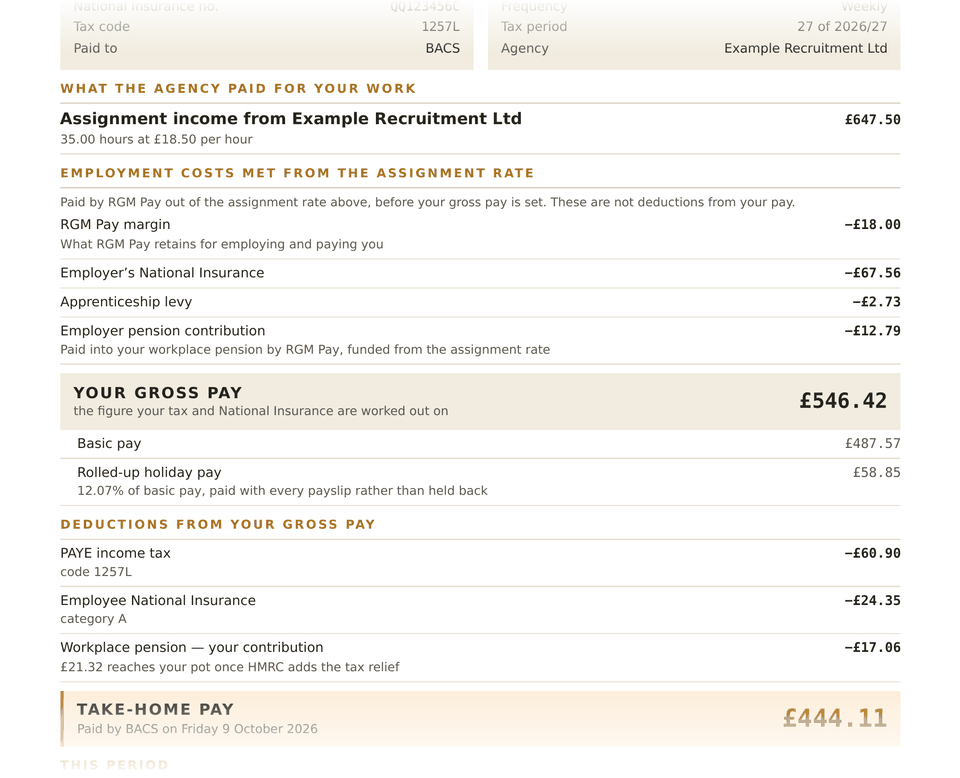
The same lines as the breakdown above, in the document you would actually receive.
Every figure on it matches the calculator on this page for a worker on £18.50 an hour across 35 hours, so you can check one against the other rather than take either on trust. The assignment rate is at the top, the four employment costs come out of it before a gross wage exists, and the three deductions from gross pay are listed separately underneath.
The worker, the agency and the reference numbers are invented, and the document says so across the top. It is there to show you the layout and the arithmetic before you join, not to stand in for your own payslip. Yours will carry your tax code, your hours and your own year-to-date figures, and a Key Information Document with the numbers specific to your assignment is issued before you start.
What contractors ask us
The ones that come up on nearly every call. If yours is not here, ask us and we will add it.
What exactly does an umbrella company do?
We become your legal employer for the assignments the agency places you on. We run your PAYE, make the statutory deductions, issue your payslip and pay you, so you are employed and paid compliantly without setting up a limited company of your own. The agency still finds you the work; we handle the employment behind it.
Why is the umbrella rate higher than the PAYE rate I was quoted?
Because it has to cover the cost of employing you, which on a PAYE rate the agency carries separately. An umbrella assignment rate of £22.50 and an agency PAYE rate of £18 are not two offers of different generosity; they are the same job priced two different ways. Compare them on take‑home, never on the headline rate. The calculator above is there for exactly that.
Why does employer's National Insurance come out of my rate?
Because in umbrella work the assignment rate is the whole cost of employing you, not a wage. Employer's National Insurance, the apprenticeship levy, the employer pension contribution and our margin all come out of it before you have a gross wage. That is how every compliant umbrella works; it is not a fee and we keep none of it. What varies between providers is whether they show you each line or bury them in one figure. We show them.
When do I actually get paid?
Friday, which is standard across the sector. That holds on one condition: we need both your timesheets and cleared funds from the agency by Wednesday evening, or Thursday morning at the latest. We state the cut‑off rather than leaving it unsaid, because no umbrella can pay out money it has not yet received. A provider promising Friday pay without naming a deadline is either absorbing that risk quietly or missing it quietly. If timesheets or funds land after the cut‑off we will try to run an off‑cycle payment as soon as the money clears; where that is not possible it moves to the following Friday. Either way you will be told which, rather than left to find out on payday.
What is rolled-up holiday pay, and when do I get it?
Holiday pay at 12.07% of your pay for time worked, paid to you every payslip as its own separate line rather than held back until you take leave. You still have the leave; you are simply paid for it as you go. It is shown separately because it has to be, and because a payslip that folds it into one figure makes it impossible to check you were paid it at all.
Do I have to stay in the workplace pension?
No. Auto‑enrolment means you are put into it, and you can opt out. Worth understanding first. Auto‑enrolment puts 8% of qualifying earnings into your pot: 4% leaves your pay, HMRC adds 1% as tax relief, and we add 3%. Our 3% comes out of your assignment rate too, so you fund seven of the eight points. If you opt out, both contributions stop coming out of the rate and your take‑home goes up, but the money arrives taxed, and you lose the relief. Run both settings on the calculator and compare before you decide.
What does the £18 margin actually cover?
It is the only line on your payslip we keep. It is our charge for employing you and running the payroll: PAYE and National Insurance calculated and submitted to HMRC, your payslip, your holiday pay, pension administration and someone to ring when something looks wrong. It is fixed at £18 a week, £72 four‑weekly or £78 monthly, £936 a year whichever applies, so it does not rise with your rate. The more you earn, the smaller a share of your pay it is.
It also costs you less than the headline figure, because it comes out of the assignment rate before you have a gross wage, so it reduces the pay that tax and National Insurance are charged on. For a basic-rate taxpayer opted out of the workplace pension, £18 a week works out at about £11.22 of take-home, £72 four‑weekly at £44.88 and £78 monthly at £48.62 — £583.44 a year whichever applies. Staying in the pension or paying higher-rate tax changes it. This is true of every compliant umbrella margin, not just ours; the breakdown above shows your own figures.
Could I be paid less than the minimum wage?
Not through us. Because employment costs come out of the assignment rate before your wage exists, a rate that looks like the minimum wage does not produce one, and holiday pay cannot be counted towards it either. For a worker aged 21 or over on 37.5 hours, the assignment rate has to be at least £16.55 an hour, or £16.88 if you stay in the pension. The calculator above refuses to price anything below that floor, and we will not run an assignment that cannot clear it.
What is a Key Information Document?
A document you must be given before you start, setting out who employs you, what you will be paid, every deduction that will be made and an illustration of your take‑home. Yours is issued before the first assignment begins. The calculator on this page is an illustration; the Key Information Document carries the figures specific to your assignment.